mirror of
https://github.com/outbackdingo/firezone.git
synced 2026-03-21 11:41:51 +00:00
 5e16a0c849
* add azure ad docs

* re-add idp instructions

* update azure AD doc

* edit google auth doc for oidc

* update okta documentation for oidc

* update azure gif

* fix lint errors

* title case

* update for review notes

* changing references of base URL to external URL

* make notes consistent to discourage basic OAuth vs OIDC

* add offline_access scope for azure

* wip upgrade docs

* update azure doc and upgrade instructions

* update Okta doc

* trailing whitespace

* add docs for offline access

* consistent code placeholder formatting

* update upgrade docs

* update image title
4.4 KiB
4.4 KiB
layout, title, nav_order, has_children, has_toc, description
| layout | title | nav_order | has_children | has_toc | description |
|---|---|---|---|---|---|
| default | Authenticate | 3 | true | false | This page documents all the authentication methods that Firezone supports. |
 {:width="600"}
By default, Firezone uses local email/password authentication, but can also
support integration with any generic OpenID Connect
(OIDC) identity provider. This allows users to sign in to Firezone using
their credentials from Okta, Google, Azure AD, or your own custom identity provider.
## Integrating A Generic OIDC Provider
The example below details the config settings required by Firezone to enable SSO
through an OIDC provider. The configuration file can be found at
{:width="600"}
By default, Firezone uses local email/password authentication, but can also
support integration with any generic OpenID Connect
(OIDC) identity provider. This allows users to sign in to Firezone using
their credentials from Okta, Google, Azure AD, or your own custom identity provider.
## Integrating A Generic OIDC Provider
The example below details the config settings required by Firezone to enable SSO
through an OIDC provider. The configuration file can be found at
/etc/firezone/firezone.rb. To pick up changes, run firezone-ctl reconfigure
and firezone-ctl restart to update the application.
ruby # This is an example using Google and Okta as an SSO identity provider. # Multiple OIDC configs can be added to the same Firezone instance. default['firezone']['authentication']['oidc'] = { google: { discovery_document_uri: "https://accounts.google.com/.well-known/openid-configuration", client_id: "<GOOGLE_CLIENT_ID>", client_secret: "<GOOGLE_CLIENT_SECRET>", redirect_uri: "https://firezone.example.com/auth/oidc/google/callback", response_type: "code", scope: "openid email profile", label: "Google" }, okta: { discovery_document_uri: "https://<OKTA_DOMAIN>/.well-known/openid-configuration", client_id: "<OKTA_CLIENT_ID>", client_secret: "<OKTA_CLIENT_SECRET>", redirect_uri: "https://firezone.example.com/auth/oidc/okta/callback", response_type: "code", scope: "openid email profile offline_access", label: "Okta" } }
1. discovery_document_uri: This URL returns a JSON with information to
construct a request to the OpenID server.
1. client_id: The client ID of the application.
1. client_secret: The client secret of the application.
1. redirect_uri: Instructs OIDC provider where to redirect after authentication.
This should be your Firezone EXTERNAL_URL + /auth/oidc/<provider_key>/callback/
(e.g. https://firezone.example.com/auth/oidc/google/callback/).
1. response_type: Set to code.
1. scope: OIDC scopes
to obtain from your OIDC provider. This should be set to openid email profile
or openid email profile offline_access depending on the provider.
1. label: The button label text that shows up on your Firezone login screen.
We've included instructions on how to set up Firezone with several popular
identity providers:
* [Azure AD]({%link docs/authenticate/azure-ad.md%})
* [Google]({%link docs/authenticate/google.md%})
* [Okta]({%link docs/authenticate/okta.md%})
* [Local email/password authentication (default)]({%link docs/authenticate/web-auth.md%})
If your identity provider is not listed above, but has a generic OIDC
connector, please consult their documentation to find instructions on obtaining
the config settings required.
Join our Slack to request additional help or
open a Github Issue to request
additional documentation for your provider.
## Enforce Periodic Re-authentication
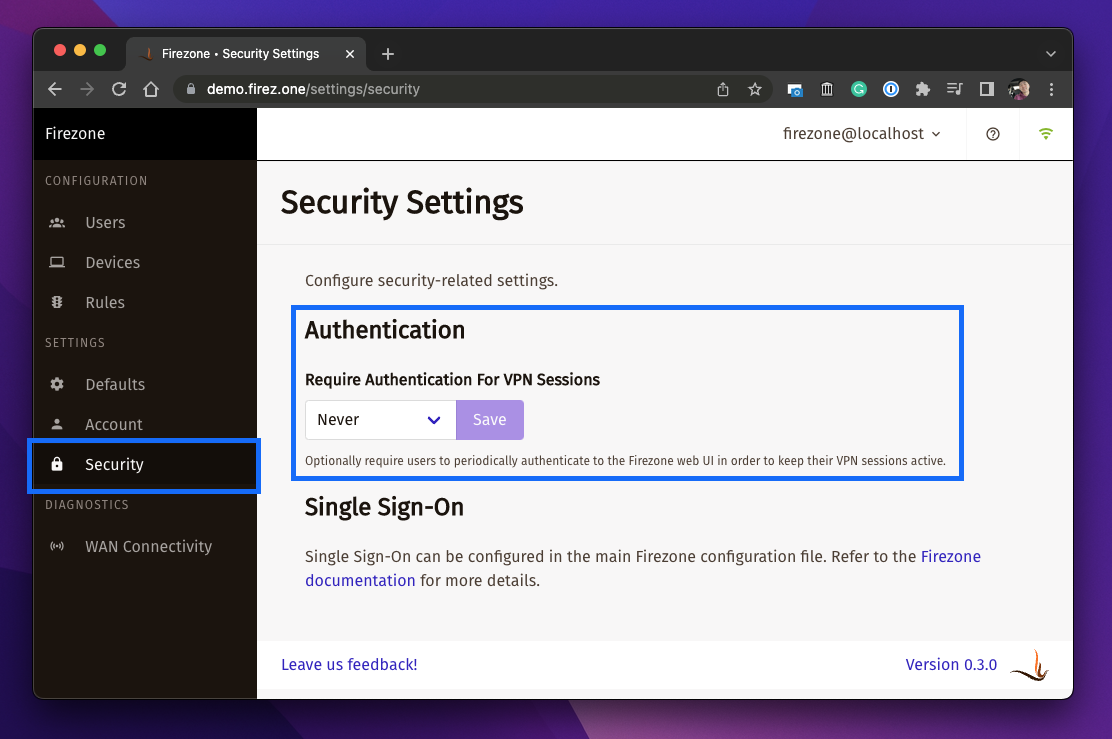
Periodic re-authentication can be enforced by changing the setting in
settings/security. This can be used to ensure a user must sign in to Firezone
periodically in order to maintain their VPN session.
 {:width="600"}
You can set the session length to a minimum of 1 hour and maximum of 90 days.
Setting this to Never disables this setting, allowing VPN sessions indefinitely.
This is the default.
To re-authenticate an expired VPN session, a user will need to turn off their
VPN session and sign in to the Firezone portal (URL specified during
[deployment]({%link docs/deploy/prerequisites.md%})
).
See detailed Client Instructions on how to re-authenticate your session
[here]({%link docs/user-guides/client-instructions.md%}).
{:width="600"}
You can set the session length to a minimum of 1 hour and maximum of 90 days.
Setting this to Never disables this setting, allowing VPN sessions indefinitely.
This is the default.
To re-authenticate an expired VPN session, a user will need to turn off their
VPN session and sign in to the Firezone portal (URL specified during
[deployment]({%link docs/deploy/prerequisites.md%})
).
See detailed Client Instructions on how to re-authenticate your session
[here]({%link docs/user-guides/client-instructions.md%}).