 eda62ff77b
Overview

This pull request introduces the integration of External-DNS into the
full bundles and adds support for a dns01 ClusterIssuer using
Cloudflare. It enhances the DNS management capabilities for our
deployments by allowing dynamic DNS record management directly from
Kubernetes resources.

Changes Made

 1. **External-DNS Integration:**

   - Added External-DNS to the full deployment bundles.

- Configured External-DNS to automatically manage DNS records for
services within the Kubernetes cluster ( we must discuss how to
configure external-dns via configmap or create an application in tenant
`external-dns` where we can define values).

We must define some additional annotations for ingresses in order to
make external-dns work , so we must discuss this also which is best
method to configure it ( from configmap or dashboard ).

**2. dns01 ClusterIssuer for Cloudflare:**

- Implemented support for a dns01 ClusterIssuer using Cloudflare.
- This allows for automated certificate issuance via DNS challenge,
leveraging Cloudflare as the DNS provider.
- The configuration can be defined in the Cozystack ConfigMap

3. Default Ingress Configuration:

- Updated the default Ingress resources to use Cloudflare for DNS
challenges.
- Ensured that if the Cloudflare issuer is defined in the Cozystack
ConfigMap, it will be utilized for all default Ingresses, streamlining
the deployment process and improving reliability.

**Benefits**

- Automated DNS Management: With External-DNS, DNS entries will be
created and updated automatically based on the state of Kubernetes
resources, reducing manual overhead.
- Seamless Certificate Management: The dns01 ClusterIssuer integration
allows for automated SSL/TLS certificate issuance, enhancing security
for deployed applications.
- Flexibility in Configuration: Users can easily switch between
different issuers by updating the Cozystack ConfigMap, providing
flexibility in the choice of DNS and certificate management solutions.

<!-- This is an auto-generated comment: release notes by coderabbit.ai
-->
## Summary by CodeRabbit

## Release Notes

- **New Features**
- Introduced a new `external-dns` release with support for managing DNS
records in Kubernetes.
- Added configuration options for DNS synchronization policies and
provider settings.
  - Implemented a new lookup for issuer types in Ingress configurations.
- Expanded configuration with new entries for `external-dns` in multiple
deployment files, enhancing deployment flexibility.

- **Documentation**
- Comprehensive README and configuration schema for the `external-dns`
Helm chart added, detailing installation and customization options.

- **Improvements**
  - Enhanced RBAC configuration for flexible permissions management.
- Updated annotations and health check configurations for better service
monitoring.
<!-- end of auto-generated comment: release notes by coderabbit.ai -->

---------

Signed-off-by: Andrei Kvapil <kvapss@gmail.com>
Co-authored-by: Andrei Kvapil <kvapss@gmail.com>
Co-authored-by: coderabbitai[bot] <136622811+coderabbitai[bot]@users.noreply.github.com>







Cozystack
Cozystack is a free PaaS platform and framework for building clouds.
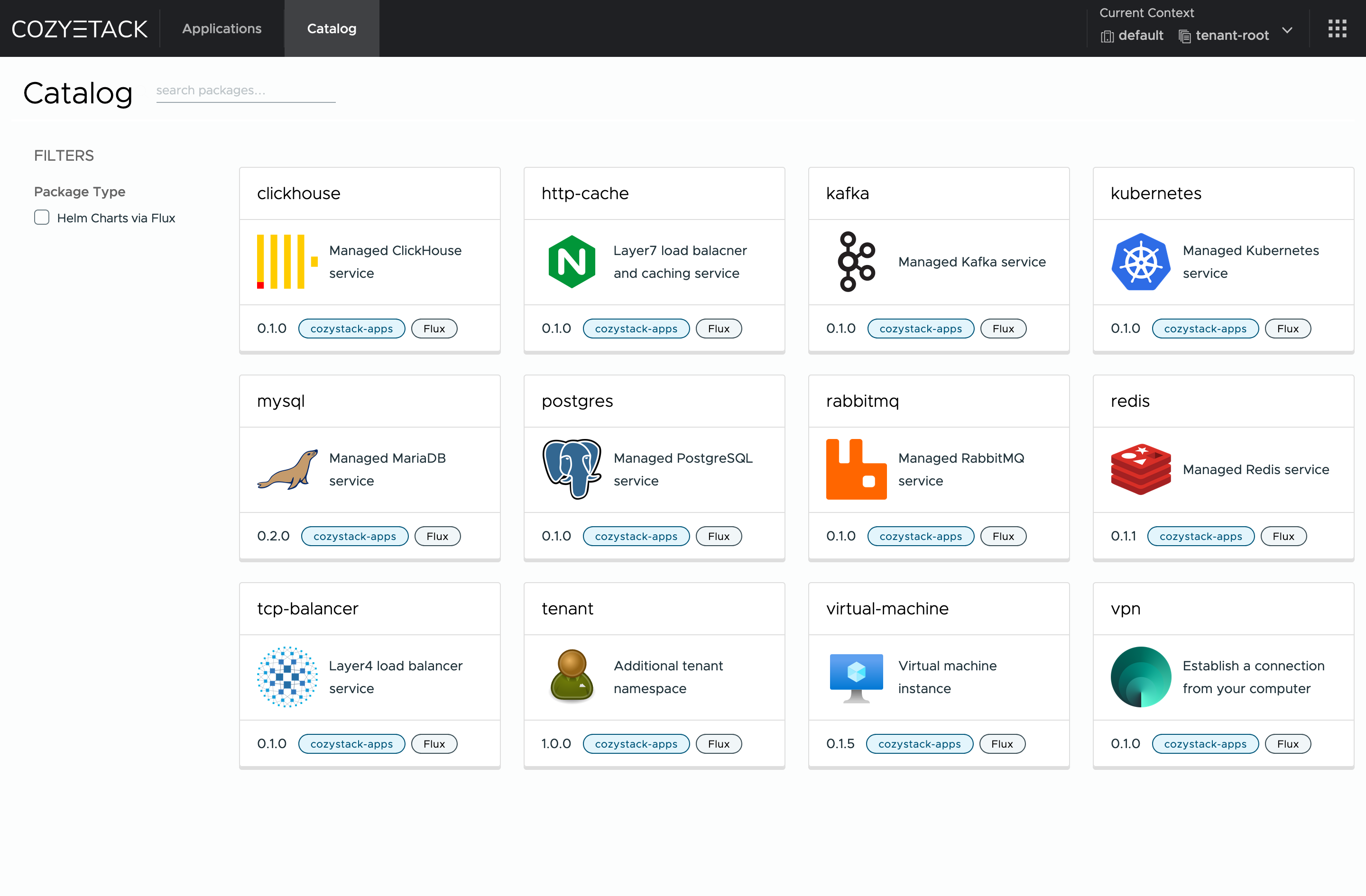
With Cozystack, you can transform your bunch of servers into an intelligent system with a simple REST API for spawning Kubernetes clusters, Database-as-a-Service, virtual machines, load balancers, HTTP caching services, and other services with ease.
You can use Cozystack to build your own cloud or to provide a cost-effective development environments.
Use-Cases
-
Using Cozystack to build public cloud
You can use Cozystack as backend for a public cloud -
Using Cozystack to build private cloud
You can use Cozystack as platform to build a private cloud powered by Infrastructure-as-Code approach -
Using Cozystack as Kubernetes distribution
You can use Cozystack as Kubernetes distribution for Bare Metal
Screenshot
Documentation
The documentation is located on official cozystack.io website.
Read Get Started section for a quick start.
If you encounter any difficulties, start with the troubleshooting guide, and work your way through the process that we've outlined.
Versioning
Versioning adheres to the Semantic Versioning principles.
A full list of the available releases is available in the GitHub repository's Release section.
Contributions
Contributions are highly appreciated and very welcomed!
In case of bugs, please, check if the issue has been already opened by checking the GitHub Issues section. In case it isn't, you can open a new one: a detailed report will help us to replicate it, assess it, and work on a fix.
You can express your intention in working on the fix on your own. Commits are used to generate the changelog, and their author will be referenced in it.
In case of Feature Requests please use the Discussion's Feature Request section.
You can join our weekly community meetings (just add this events to your Google Calendar or iCal) or Telegram group.
License
Cozystack is licensed under Apache 2.0.
The code is provided as-is with no warranties.
Commercial Support
Ænix offers enterprise-grade support, available 24/7.
We provide all types of assistance, including consultations, development of missing features, design, assistance with installation, and integration.