 f97f673de0
I saw your call for adopters - I am sort of in production now, but not
with any services that I can advertise.

This Urmanac is something I'm testing on WASM workloads. I also have
hosted some Ruby services on my cluster. I am still in the
proof-of-concept phase with my production workloads, working towards a
service level of 99.5% or better. I am running SpinKube on Cozystack,
with my own Talos Linux image that I have built to add the Spin and
Tailscale extensions.

(The urmanac is in beta at: https://beta.urmanac.com - urmanac.com is a
dead link for now.)

What's holding me back currently is hardware, not so much the software
stack. I have deployed Cozystack on some severely under-powered
machines. Every time I push it to the limit, my load averages shoot up
into the 100's and I unfortunately bring my control plane and services
down. I will probably get better results when I am able to separate the
KubeVirt clusters from the data plane and control plane. When the load
rises too high, etcd becomes unresponsive, and it goes downhill from
there.

I am very impressed with the architecture of Cozystack and I have made
some contributions to Cozystack on behalf of the FluxCD community! I am
in firm support of your goal to join the CNCF.

<!-- This is an auto-generated comment: release notes by coderabbit.ai
-->

## Summary by CodeRabbit

- **New Features**
- Added "Urmanac" to the Cozystack Adopters list, including contact
information and a description of its use of Cozystack.

- **Documentation**
  - Reformatted the existing entry for "gohost" for consistency.

<!-- end of auto-generated comment: release notes by coderabbit.ai -->

Signed-off-by: Kingdon Barrett <kingdon+github@tuesdaystudios.com>







Cozystack
Cozystack is a free PaaS platform and framework for building clouds.
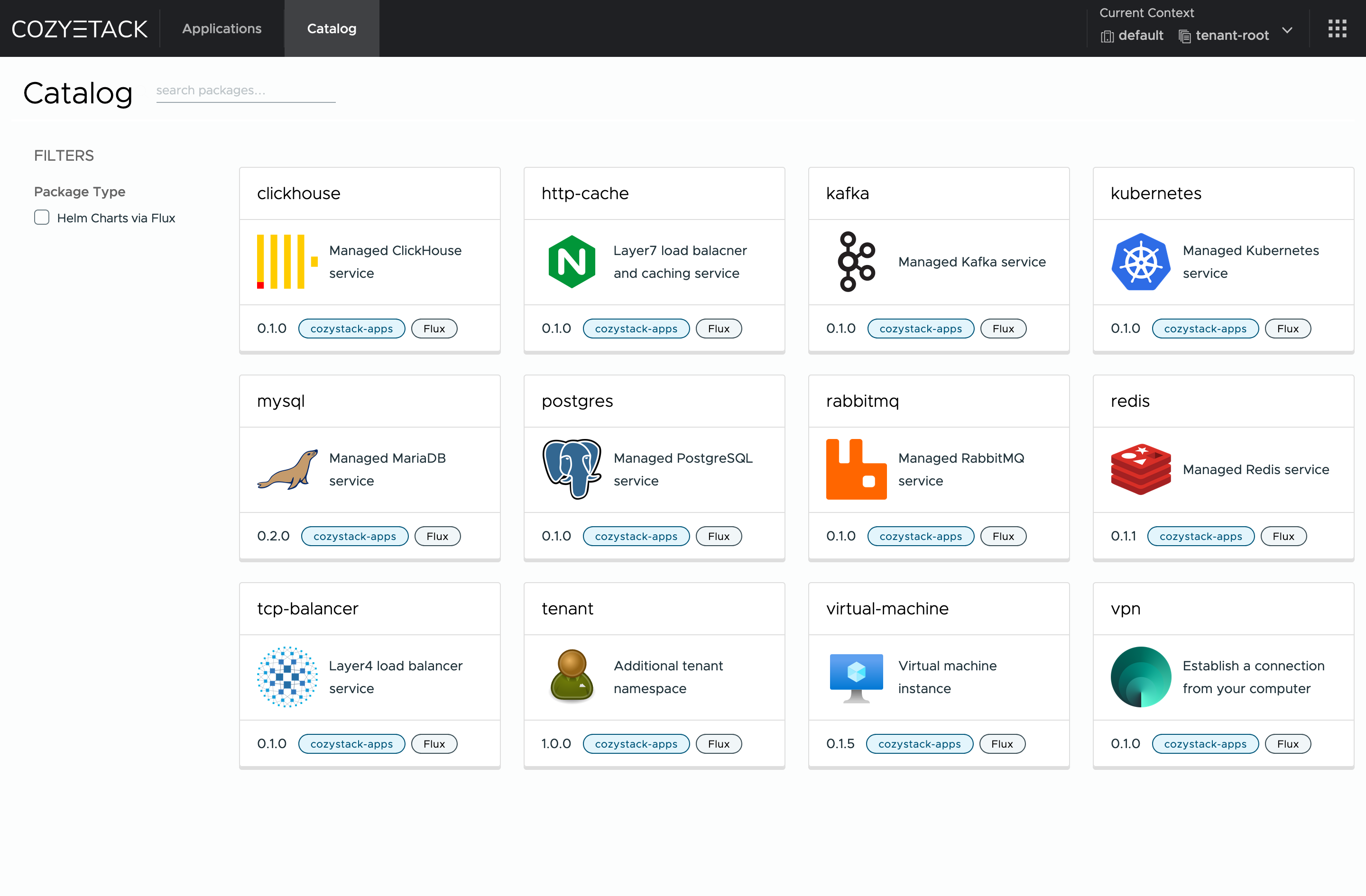
With Cozystack, you can transform your bunch of servers into an intelligent system with a simple REST API for spawning Kubernetes clusters, Database-as-a-Service, virtual machines, load balancers, HTTP caching services, and other services with ease.
You can use Cozystack to build your own cloud or to provide a cost-effective development environments.
Use-Cases
-
Using Cozystack to build public cloud
You can use Cozystack as backend for a public cloud -
Using Cozystack to build private cloud
You can use Cozystack as platform to build a private cloud powered by Infrastructure-as-Code approach -
Using Cozystack as Kubernetes distribution
You can use Cozystack as Kubernetes distribution for Bare Metal
Screenshot
Documentation
The documentation is located on official cozystack.io website.
Read Get Started section for a quick start.
If you encounter any difficulties, start with the troubleshooting guide, and work your way through the process that we've outlined.
Versioning
Versioning adheres to the Semantic Versioning principles.
A full list of the available releases is available in the GitHub repository's Release section.
Contributions
Contributions are highly appreciated and very welcomed!
In case of bugs, please, check if the issue has been already opened by checking the GitHub Issues section. In case it isn't, you can open a new one: a detailed report will help us to replicate it, assess it, and work on a fix.
You can express your intention in working on the fix on your own. Commits are used to generate the changelog, and their author will be referenced in it.
In case of Feature Requests please use the Discussion's Feature Request section.
You can join our weekly community meetings (just add this events to your Google Calendar or iCal) or Telegram group.
License
Cozystack is licensed under Apache 2.0.
The code is provided as-is with no warranties.
Commercial Support
Ænix offers enterprise-grade support, available 24/7.
We provide all types of assistance, including consultations, development of missing features, design, assistance with installation, and integration.